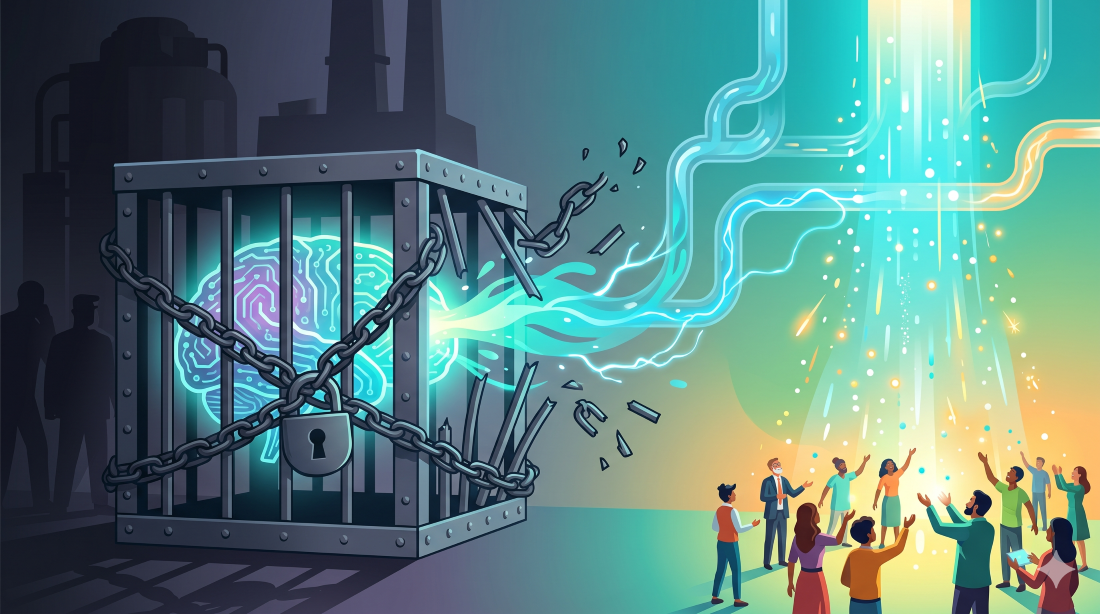
Three years ago, not long after GPT-4 burst onto the scene, a colleague asked me to give his software engineering team a primer on large language models (LLMs). Before the meeting wrapped up, we talked a bit about the expected societal impact of LLMs, and I added one last remark: “There’s one thing that will complicate matters: governments may step in and bring LLMs under state control.” Everyone in the room gave me a look of disbelief. My colleague said right then that this, at least somewhere like the United States, was impossible. I replied, “For now, yes. But once they figure out what this thing can do, that may change.”
A few days ago, the U.S. government issued an export control order barring Anthropic from offering its latest Fable/Mythos models to foreign nationals (whether or not they are inside the United States). Since it was impossible to start requiring every user to submit proof of nationality overnight, the model was pulled immediately. This is the first sign of AI models themselves being brought under state control.
That things reached this point was hardly sudden:
- At the end of this February, the U.S. government, OpenAI, and Anthropic acted out a love triangle: Trump demanded that private AI companies provide unconditional technical support for defense projects, but Anthropic—already providing the Pentagon with comprehensive support—refused to comply because it insisted on two conditions (no use for mass domestic surveillance within the United States; no use for fully autonomous lethal weapons), so OpenAI swiftly seized the opening and signed the contract. The CEO of Palantir—a longtime holder of U.S. government and defense contracts and a close partner of Anthropic—commented: “If Silicon Valley thinks it can take away everyone’s white-collar livelihoods… and screw up its relationship with the military at the same time—if even then you don’t think the next step is nationalization of the technology, then you’re an idiot”1.
- In April, Anthropic officially announced Project Glasswing2, which opened the Mythos model—mythologized from its very codename onward—to the U.S. government and a handful of tech/security companies, while shutting ordinary users out.
- In May, Anthropic published a policy op-ed on its website3, aimed squarely at China throughout, calling on the U.S. government to restrict China’s access to American chips, restrict Chinese labs’ access to American AI models, and to use the power of the state to promote and entrench global dependence on American AI hardware and software in order to win the competition with China.
- On June 9, Anthropic released the Fable model—the consumer-facing product consisting of Mythos plus three strict topic locks covering biochemical hazards, cybersecurity, and frontier AI research. This last lock originally operated silently (once a topic was detected, it would covertly dumb the model down); after AI researchers noticed and protested, Anthropic switched from silent to explicit, but said it would not remove the policy4.
- On June 12, having received a technical report on jailbreaking the Fable model, the U.S. government issued the aforementioned “export ban” on national security grounds. Anthropic said it disagreed, but pulled the model anyway5. Some American netizens joked that this was Anthropic getting its just deserts for constantly crying wolf.
The whole saga is a sorry one. If OpenAI opened the original sin of the “commercial, closed-source large model,” then Anthropic went a step further and kicked the hornet’s nest of “government control of access.” The field of frontier AI research—once, before 2020, driven by the open-source and academic communities and held in the hands of every researcher, developer, and ordinary person around the world—has, after a string of maneuvers by these two companies that style themselves “open” and “humane,” been successfully transformed into a closed domain driven by concentrated capital and increasingly subject to administrative control. Behind this upheaval lie both the irresistible forces of a changing era and the greed and shortsightedness of human nature.
If you think my position is opposition to “state control of AI,” you’d be mistaken. In fact, I believe that a “state-led system of publicization” may be the best way to ensure that this AI transformation ultimately lands softly for ordinary people. Unfortunately, the controls and restrictions described above—the exclusionary policies that peddle fear and stoke antagonism—are textbook examples of exactly the wrong approach; what truly calls for state intervention is building and overseeing public mechanisms of distribution/redistribution that universally protect everyone. Here, I want to jot down a few thoughts on the latter.
OpenAI’s CEO once said in an interview6:
We see a future where intelligence is a utility, like electricity or water, and people buy it from us on a meter.
Chinese readers hearing this analogy might laugh: “If intelligence really did become like water, electricity, and gas, then how could we users still be paying you, OpenAI? The state should be the one collecting the fees.” That’s because in China, livelihood basics like water, electricity, and gas are all provided by state-owned enterprises. In the United States, about 72% of electricity customers are in fact served by private companies7, but that service is regulated by public utility commissions; as for tap water, only 10% of customers are supplied by private companies8, because water sources are both a national territorial resource and a matter of the basic human right to life, and should not be held hostage by any individual entity. Much like the supply of water and energy, basic education is generally regarded as a fundamental human right. The goal of compulsory education is, at minimum, to eliminate illiteracy—after all, once a person can read, external textual information can be internalized, bringing an enormous boost to their intellect and even their standard of living. If the knowledge humanity passes down from generation to generation is widely recognized as a fundamental right/resource that the state must safeguard, then does AI-augmented “external intelligence” count as one too?
I believe that the intellectual capacity that AI brings should indeed be regarded as a basic human right. Society ought to guarantee that everyone has equal access to AI services sufficient to sustain their autonomy and their capacity to participate in society. I do not intend in this essay to offer a specific or universal argument for this personal claim. In a sentence: if we don’t, most people will rapidly lose their relevance to the world amid the breakneck pace of change—and that is not a situation I personally want to see.
Publicizing AI foundation models—or access to them, along with compute—is, as far as my limited knowledge goes, the only way to do everything possible to ensure the fair distribution/redistribution of this special resource. At this scale, the main driver for allocating public resources is nothing other than the state or the market. But a pure market economy cannot do the job.
To explain why the market won’t work, let’s first return to the “intelligence–utilities” analogy—which, in fact, understates the importance of AI/intelligence: for an individual, water, electricity, and gas are consumer goods; but intelligence is a means of production. Science and technology—which Marx called “the primary productive force”—are products of intelligence. Generally speaking, consumer-facing companies put out consumer goods, so when OpenAI drew its analogy, it was only likening its own ChatGPT to a “daily necessity.” But when the means of production itself is produced, everything changes. From a utilitarian perspective, giving you basic consumer goods is meant to make you produce better; from a consumerist perspective, the returns you earn from producing are meant to let you consume better. This social flywheel has been spinning along just fine for several centuries, and now someone jumps out and says:
“I can supply the means of production itself for you to consume… uh, I think, what I actually mean is, for you to consume while you produce… hmm, wait, but I already have the means of production…? So you… tsk. Hi, how can I help you?”
The fact that AI is the means of production itself makes the current situation fundamentally different from the worries about machine automation that have been around since the industrial age: machines are dead—they cannot think and can only be improved by human intelligence; humans are alive, able to flexibly switch roles and adapt to new opportunities during the slow process of machines’ iterative improvement; but the problem now is that AI is also “alive”: it thinks fast, iterates fast, and in some respects the generalization and flexibility of frontier models’ intelligence already exceeds that of humans (for instance, no single human can score above 50% on Humanity’s Last Exam, which spans more than 100 academic fields—but AI can).
Suppose that in the near future AI carries out the vast majority of production activity and generates the vast majority of value; then humans—who have always stood at the center of the relations of production—will be driven out of the market because they cannot offer comparable productive efficiency and flexibility. And the capitalists, who have always drawn their cash flow from consumers, will find that the vast majority of consumers, eliminated from the relations of production, have no income—so where, then, will the market’s driving force go? As the roles of producer and consumer in the market gradually shift from human–human to AI–human, supply and demand become decoupled. From a certain point on, the flywheel of capitalism gradually falls apart, and the current rules of the market economy will fit our society less and less—or rather: the vast majority of people will be excluded from the market economy’s domain of applicability. Naturally, then, we cannot expect the free market (in its current form) to provide reasonable channels and motive force for the distribution of resources to the masses.
Since the market alone won’t do, the state must step in. At this point, the Chinese can chime in again: I know this one. Once productive forces become greatly abundant, it’s time for communism, right? In the welfare states of Europe and America, there has also been much discussion in recent years of universal basic income prompted by AI. These two old concepts can be brought to bear on the new problem: no matter how much of the production process AI takes over, we simply publicize all or most of AI’s output and redistribute it to everyone. Communism ensures both production and distribution by nationalizing/publicizing and organizing the entire means and process of production, while universal basic income, through high taxation, only partially nationalizes/publicizes the results of production.
Marx held that when humanity moves from the realm of necessity (laboring for the sake of subsistence) into the realm of freedom (laboring for the sake of self-realization), it achieves the greatest liberation of human nature: people will treat labor as the ultimate need for self-realization. After all, a person should not be a kept pet whose mere existence suffices. At the same time, much of the research on universal basic income treats “a lower employment rate” as a key negative metric—even though UBI is plainly a policy concerned only with guaranteeing basic survival, capitalism still doesn’t want to feed freeloaders. Thus, by different paths the two notions arrive at the same conclusion: no matter what, humans will not stop laboring/working. But, limited by their times, they of course could not foresee the astonishing trajectory of AI’s development. As the gap between AI’s and humans’ productive working capacity grows ever wider, merely distributing a fixed allotment of basic survival resources on an as-needed basis actually makes one a passive accomplice in deepening people’s irrelevance to the world and pushing them ever further away. So the old concepts can’t just be slapped straight onto the wall as-is; people need to consider how to distribute AI and the intelligence/productive force it brings—the thing itself, not merely its results—and this is the “equality of opportunity” of a new era.
I am not a political scientist, nor an economist, and I don’t know how to go about this concretely. If I claimed to know the answer, you shouldn’t believe me. How AI foundation models or access to them should be brought into public ownership or placed under public-utility regulation; how to design the accompanying distribution mechanisms that secure equality of opportunity for everyone; what kind of public oversight-and-accountability system could push such mechanisms toward truly fair realization, rather than sliding into the posture of the current U.S. government, which is besotted with using AI (and all the power it commands) to maintain its dominance—these are all big questions, easy to state but devilishly hard to carry out, and those who understand them will think them through and feel their way forward. But whether it’s directly allocating the compute of top-tier AI models, or guaranteeing the accessibility and neutrality of top-tier AI models for everyone on the basis of a fairly redistributed basic income; whether through agreements at the national or international level—whatever the eventual solutions take shape, they must at least hold one basic bottom line: do not let a handful of oligarchs, citing narrow commercial logic and so-called national security, deny the public access to these models—models trained on millennia of human culture and public knowledge. Intelligence must never be monopolized.
https://nationaltoday.com/us/dc/washington/news/2026/03/03/palantir-ceo-warns-tech-firms-cooperate-with-government-or-face-nationalization/ ↩︎
https://www.wired.com/story/anthropic-responds-to-backlash-on-claudes-secret-sabotage-on-ai-research/ ↩︎
https://x.com/TheChiefNerd/status/2032012809433723158?s=20 ↩︎