
Written in Chinese, translated by Claude Sonnet 4.5.
In one previous post, I mentioned that “the investment in making an indie game is inherently extremely difficult to break even.”
Many friends making indie games invest enormous amounts of time and energy purely out of their love for games. Like many industries, the spotlight only shines on the most popular works, while the vast majority go unnoticed. A complete game development cycle takes at least one year, and before you know it, three years have passed. In most cases, it requires a multi-person team with complementary skills (otherwise it takes even longer: Stardew Valley took five years, Animal Well took seven). Yet the return on investment curve corresponding to these steep labor costs is extremely flat.
Today is a day off, so instead of making games, I’ll pull some data to demonstrate that “making indie games, 95% will lose money” to motivate (?) myself.
There’s a public Steam dataset on Kaggle that updates monthly. As of October this year, there are a total of 97,410 games on Steam. I applied the following filters:
Total of 97,410 games in the database:
- Released between August 1, 2019 and August 1, 2024 (looking at the last five years; 66,203 remaining)
- Single-player games supporting English or Chinese (relevant audience; 40,329 remaining)
- Primary genre includes “Indie” tag (unreliable, but excludes some major publishers; 28,739 remaining)
- US region price between $3-30 (common indie game price range; 15,676 remaining)
Steam games’ actual sales numbers are naturally not public, but game reviews are publicly visible. Let’s first look at the distribution of review counts for games:
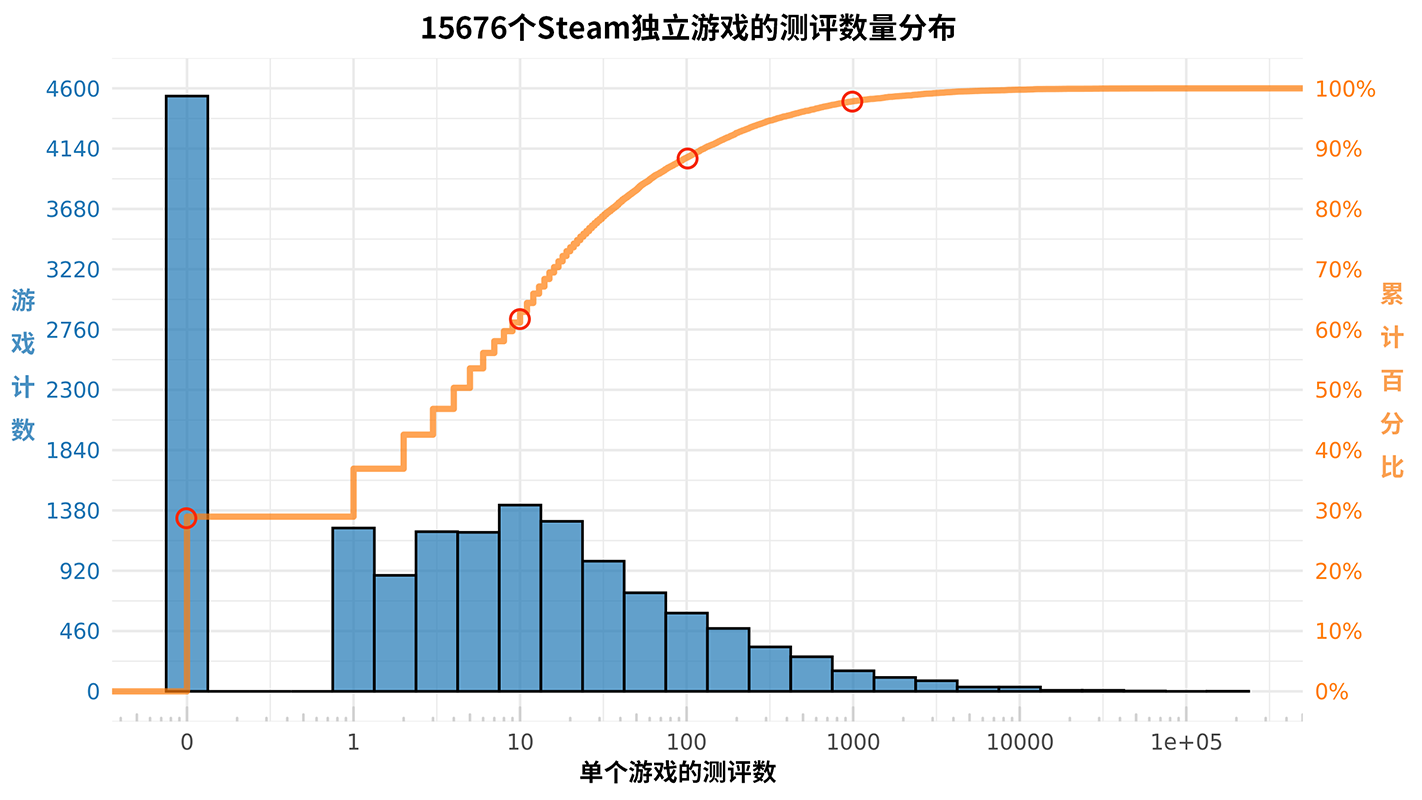
(The yellow curve represents the percentage that the sum of blue bar areas to its left represents of the total area of all blue bars)
I’ve marked four key reference points circled in red on the chart:
- 30% of games have no reviews at all
- 60% of games have 10 or fewer reviews
- Only the top 12% of games reached 100 reviews
- Only the top 2.5% of games reached 1,000 reviews
Many game developer platforms online use review counts as a key indicator for estimating Steam sales. According to analysis in this article, after 2020, approximately one player writes a review for every 20-55 copies of Steam games sold, with a median of 30 copies. So I make the following very rough estimate:
$$ Game Revenue = Review Count \times 30 \times Game Price $$Under the assumption that this estimate holds, the revenue distribution for the same 15,676 games is:
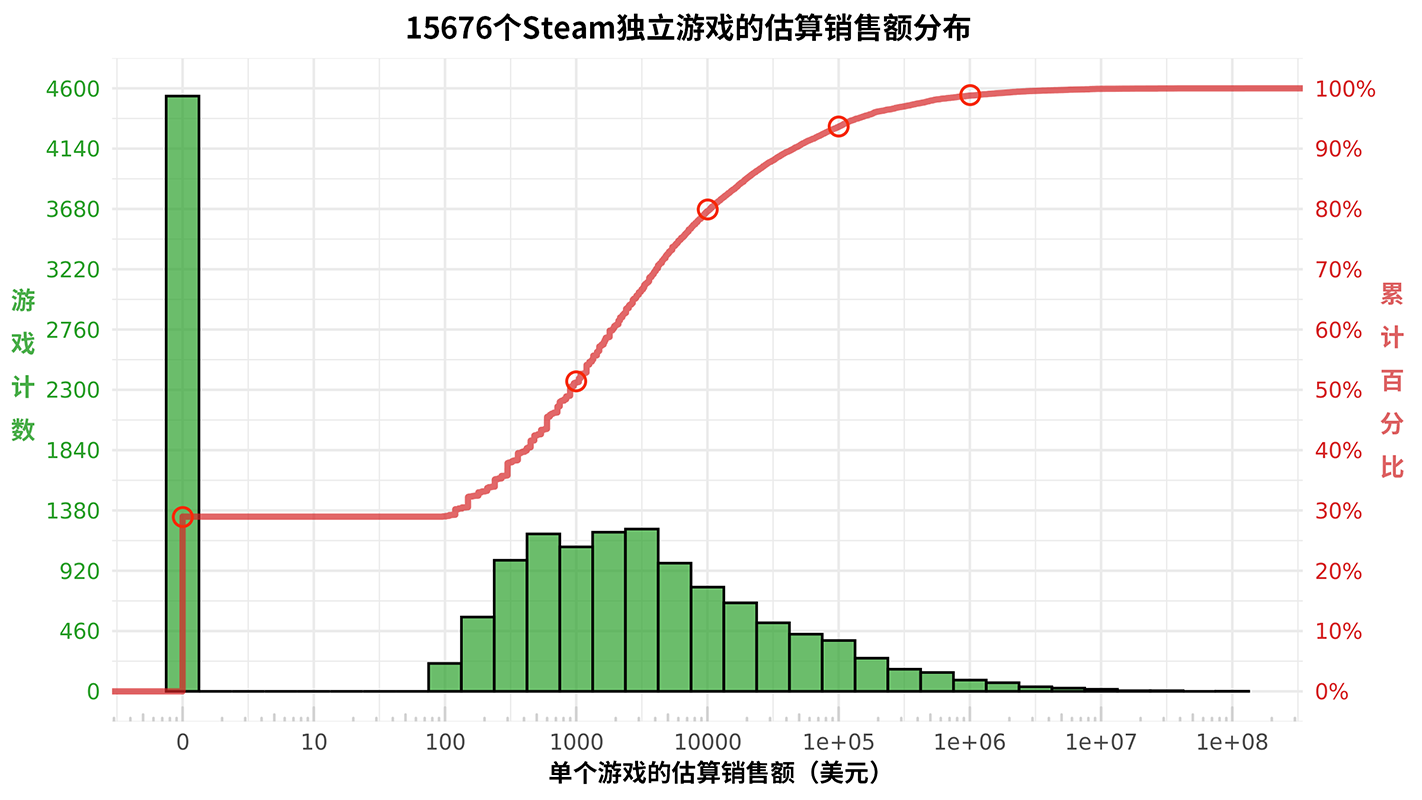
Similarly, five reference points circled in red:
- 30% of games have revenue less than $100 (estimated value when there are no reviews)
- 50% of games have revenue under $1,000
- Only the top 20% of games have revenue exceeding $10,000
- Only the top 5% of games have revenue exceeding $100,000
- The top 1% of games have revenue exceeding $1 million
$100,000 might seem like a large sum at first glance. But consider a few more points:
- This is the US region price. China region prices will be much lower after currency conversion, so domestic developers converting to RMB may need to deduct over 50%
- This is calculated at full game price. Most games have their highest sales during discounts. There are also refunds. Need to deduct another approximately 20%
- Steam platform cut. Deduct Steam’s own 30% commission on top of the above
- Taxes. Tax rates vary depending on the developer’s region and revenue amount. At least 10%
In other words, the $100,000 revenue shown in the chart, if the main player base pays at US region prices, developers might take home just over \$50,000; if it’s primarily a China region game, they might only take home around 150,000 RMB.
If it’s a three-person studio that spent one year making an indie game, then each person’s annual income is 50,000 RMB, which is barely a living wage, provided this game squeezed into the top 5% on the sales charts. If it took two years to make, this money would hardly be enough to cover one’s living expenses, let alone support a family.
Then think about the development teams of the remaining 95% of games. I’ve only heard of a 5% bottom elimination system, never heard of eliminating the bottom 95%. In other industries, squeezing into the top 5% is for great wealth and prosperity; here it’s just to avoid starvation.
Of course, I’m exaggerating, because many games aren’t developed full-time, and some practitioners receive fixed salaries. But under this overall trend, making indie games still seems like doing it for the love of it, with participants choosing a particularly time and energy-consuming way to express themselves. Somewhat clumsy. But perhaps it’s hard to find a more complete medium of expression than “creating a whole world.”